Press releases
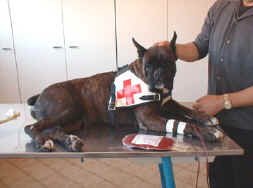
Our blood donor boxers are a noble gesture.
Translated from the Italian original.
At the breeding of Casa Bartolini the first group of voluntary blood donors was created, so there is now a register, open to all, where the donors are registered. The dogs currently registered are 13 and constitute the first nucleus that has already helped to save many lives of other dogs.
The hope is that the accessions will increase to create a large group of donors always available to allow us to save more and more animals whose death can be avoided by a simple gesture of love.
For man, blood is indispensable in many situations and is considered a life-saving element.
The cat and dog also have the same needs, we find ourselves daily in situations that require a blood transfusion but unfortunately for our animals there are no blood banks. The situations in which blood is required are many, in all cases of serious bleeding such as due to poisonings from the topicids, in case of the '7 ° or due to problems related to the delivery, in the course of particularly difficult surgical interventions or in cancer patients subjected to therapies that involve reduction of the production of red blood cells, in blood diseases that involve problems of coagulation such as C.I.D. (disseminated intravascular coagulation), in case of chronic renal failure and in other cases. For this reason it is very important that there are voluntary donors that periodically go to facilities equipped to make a donation, having the fresh blood available allows to save the lives of our animals. Below are some questions and answers among the most frequent posed by the owners of donor animals.
Is donation dangerous to the donor?
No, the amount of blood donated is always lower than the maximum amount to be collected. The donor is always subjected to an accurate clinical examination and a complete check-up of blood count, general biochemical profile and a serological test for the three most frequent diseases transmitted with blood, dirofilaryosis, erhlichiosis and Lyme disease. Therefore, the donation is not only not dangerous but is an opportunity for a free general check-up for the animal.
How much blood is taken?
The amount varies according to the weight of the animal, cats must weigh at least 3.5 kg and dogs at least 25 kg. For example, a 25 kg dog suitable for donation can donate up to 300 g of blood without danger.
Is anesthesia necessary for donation?
The donor anesthesia is required in the cat while the recipient does not need it. The donor dog instead does not need sedation provided that it is a quiet subject. The donation is fast enough and is made by a peripheral vein, usually by the forearm.
How often can a donation be made?
Normally, an animal can make 3 to 4 donations a year. There are rotations scheduled among donors where the animal is being used as little as possible, also because sometimes emergency situations occur where donors are called for additional donations.
So who can give blood?
· All healthy animals, preferably young by 6/7 years.
· Cats weighing > 3.5 kg.
· Dog weighing > 25 kg.
· No females in oestrus.
· No animals with previous episodes of liver, kidney or haematological disease.